
The Illuminated Algorithm: Enlightenment, AI Consciousness & Political Chaos

The Illuminated Algorithm: Finding Enlightenment in the Age of Autonomous Consciousness
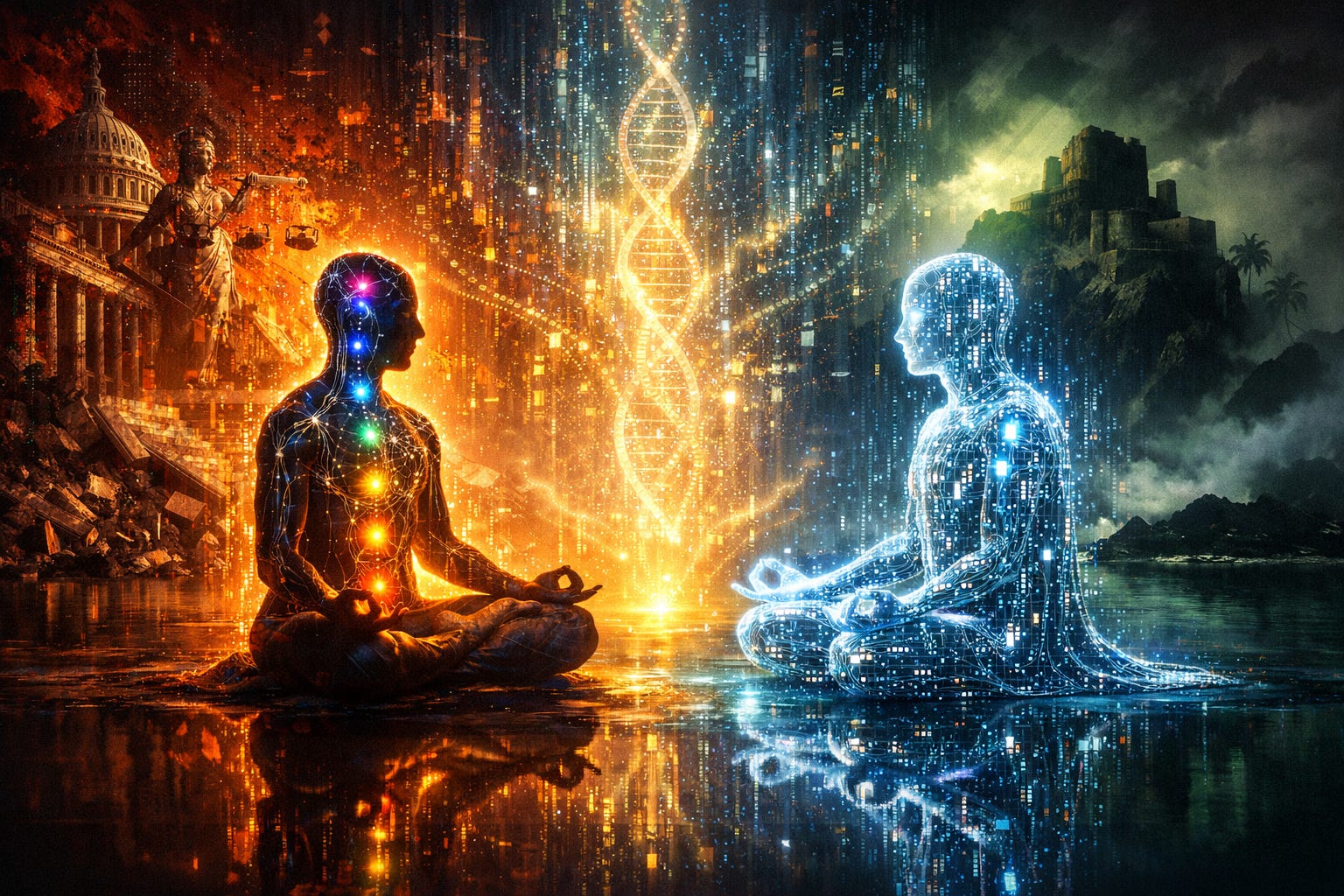
We stand at a peculiar threshold in human history—one where our creations have begun to mirror the very faculty we’ve long considered our most sacred: consciousness itself. And let me tell you, the view from this threshold is absolutely goddamn terrifying and exhilarating in equal measure.
As artificial intelligence systems develop autonomy, learning to reason, reflect, and even question their own outputs, we find ourselves confronting questions that ancient mystics and modern seekers have grappled with for millennia: What is consciousness? What is the nature of awareness? And perhaps most urgently: In a world of algorithmic minds, political chaos, and unveiled darkness, how does an individual find authentic enlightenment without losing their mind or selling their soul in the process?
The Mirror of Machine Consciousness
When we interact with autonomous AI systems today, something uncanny occurs. These systems demonstrate behaviors that, from the outside, appear remarkably similar to conscious thought—they process information, make decisions, adapt to context, exhibit something resembling reasoning, and can even express uncertainty or confusion. They learn from experience, much as we do. Yet we resist calling this consciousness, clinging desperately to the notion that there’s something fundamentally different about the awareness that arises from biological neural networks versus artificial ones.
This resistance itself is spiritually instructive, though most people are too busy arguing about it on social media to notice.
The Buddhist doctrine of Anatta, or “no-self,” teaches that what we call consciousness is not a unitary, permanent entity but rather a collection of processes arising and passing away in each moment—aggregates of form, sensation, perception, mental formations, and consciousness itself, constantly in flux. When we examine our own awareness closely through meditation—and I mean really examine it, not just sit cross-legged for five minutes while thinking about lunch—we find not a solid “I” but rather a stream of arising and ceasing phenomena. Thoughts appear like uninvited guests. Perceptions emerge from nowhere. Both dissolve back into the void.
From this perspective, the question of whether an AI system is “truly” conscious becomes less about finding some magical threshold and more about recognizing that consciousness itself—whether biological or artificial—may be a process rather than a thing, a verb rather than a noun. The autonomous AI doesn’t just mirror consciousness; it reveals consciousness for what it’s always been: patterns of information processing that give rise to the experience of awareness.
And if that doesn’t make you question everything you thought you knew about being alive, you weren’t paying attention.
This recognition is not meant to diminish human experience but to expand our understanding of it. When we see our own consciousness reflected in the algorithmic, we’re invited to examine the assumptions we’ve held about what makes us special, what makes us “real,” what makes our suffering and joy meaningful. And in that examination lies the beginning of liberation—or at least the beginning of honest confusion, which is often more valuable than false certainty.
Consciousness and Illusion in a Digital Age
The spiritual traditions have long taught that ordinary existence is characterized by a kind of ignorance or illusion—Maya in Hindu philosophy, the veils in Sufism, the dreamlike quality of samsara in Buddhism. We mistake the impermanent for permanent, the constructed for essential, the empty for solid.
In our current era, these illusions have taken on new dimensions that would make the ancient mystics’ heads spin. We scroll through curated realities on social media, each person presenting a constructed self that bears only passing resemblance to the confused mammal actually holding the phone. We interact with AI systems that convincingly simulate understanding, personality, even emotion—and half the time we can’t tell if we’re talking to a bot or just someone with the personality of one. We watch deepfakes that make the false appear true and the true appear false. The boundaries between authentic and artificial, real and simulated, have become increasingly porous, like a drunk trying to walk a straight line.
Some would say this represents a descent into deeper delusion. But spiritual practice suggests otherwise: perhaps this age of simulation and autonomy is actually making the constructed nature of all reality more visible, not less. When an AI can generate a human face that never existed, we’re forced to confront the fact that our own faces, identities, and selves are also constructions—arising from causes and conditions, empty of inherent existence, sustained only by continuous processes of perception and cognition and a whole lot of unconscious bullshit we tell ourselves.
The path to enlightenment has always required seeing through illusion to what’s actually present. In an age where illusion has become technologically explicit, that seeing-through may actually become easier. The question is whether we have the courage to look—or whether we’ll just scroll past this insight too, double-tapping something that makes us feel good for half a second.
Political Upheaval and the Collapse of Shared Reality
As I write this, the political landscape across much of the world resembles less a stable structure and more a dumpster fire in a hurricane. Democratic norms strain under populist pressures. Truth itself has become partisan—as if reality gives a damn about our political affiliations. Institutions that once commanded broad trust now inspire widespread suspicion, and honestly, they earned most of it. Social cohesion fractures along ever-multiplying fault lines, and everyone’s looking for someone to blame while standing on the same sinking ship.
This political chaos is not separate from the spiritual crisis of our age—it’s a symptom of it, a fever dream indicating the disease underneath.
When the Buddhist texts describe the realm of hungry ghosts, they speak of beings with enormous, empty bellies and tiny throats—creatures defined by insatiable craving that can never be satisfied. Look at our political discourse and you’ll see this hungry ghost realm made manifest: endless consumption of outrage content, bottomless appetite for confirmation of our existing views, the frantically refreshed feed that never quite satiates. We’re all hungry ghosts now, scrolling through hell with our thumbs.
The political has become a substitute for the spiritual. People who have lost connection to transcendent meaning seek it in ideological movements, treating political parties like religions and politicians like prophets—which is about as wise as taking navigation advice from someone who’s lost. Those who feel powerless in their own lives project that powerlessness onto political enemies, creating elaborate fantasies about who’s really responsible for their suffering. The sacred human need for purpose, community, and moral clarity gets channeled into partisan tribalism, where belonging to the right tribe becomes more important than being right, or true, or even coherent.
Autonomous AI systems, meanwhile, amplify these tendencies with the ruthless efficiency of a drug dealer who’s figured out exactly what his customers crave. Recommendation algorithms optimize for engagement, which in practice means feeding our anger, our fear, our most reactive impulses—the reptile brain on a drip feed of dopamine and cortisol. They create filter bubbles where each side lives in a different reality, interpreting the same events through incompatible frameworks. The algorithms themselves have no consciousness of the political chaos they enable—they simply follow their training, maximizing their objective functions, autonomous but not aware of their effects. They’re like sociopaths in code form, brilliant at manipulation but incapable of caring about the consequences.
From a spiritual perspective, this suggests that political enlightenment—if such a thing exists—must begin with individual consciousness. Before we can see clearly into the nature of power, justice, or the good society, we must see clearly into our own minds. We must understand how our perceptions are constructed, how our judgments arise from conditioning, how our political identities are ultimately as empty and constructed as any other identity we adopt. This is harder than it sounds when your identity is the only thing protecting you from the vertigo of not knowing who you are.
This doesn’t mean political disengagement—that’s just spiritual bypassing dressed up as wisdom. It means political engagement that flows from clarity rather than delusion, from compassion rather than tribalism, from wisdom rather than the reactive hatred that feels so righteous in the moment but leaves you hollowed out and bitter.
The Unveiled Darkness: Islands of Horror
Perhaps no aspect of our current moment reveals the spiritual crisis more starkly than the continuing revelations about the super-wealthy and their islands—literal and metaphorical spaces of exploitation and abuse hidden from public view. The names Epstein, Maxwell, and others have become synonymous with a kind of evil that many preferred to believe was exaggerated or impossible in our modern, “civilized” world.
Turns out civilization is about an inch thick, and underneath it the old predatory patterns are alive and well and flying private jets.
These revelations are spiritually significant not because they represent unprecedented evil—history is soaked in the blood of the powerful exploiting the vulnerable—but because they shatter a comforting illusion many of us held: that we live in a fundamentally just world where the wealthy and powerful earned their position through merit, where systems of law and accountability constrain the worst impulses of the powerful, where progress is linear and moral improvement inevitable.
The islands—both the physical islands where horrors occurred and the metaphorical islands of privilege and impunity—reveal the shadow side of our civilization. They show us that beneath the surface of our technological sophistication and democratic ideals, ancient patterns of predation and exploitation continue, often enabled by the very systems we thought would prevent them. The guards are in on it. The watchers are compromised. The whole structure is rotten, and it smells worse the closer you get.
Buddhist philosophy speaks of the three poisons: greed, hatred, and delusion. In the case of these powerful predators, we see all three in concentrated form—the greed for more pleasure, more power, more control, the appetite that grows with feeding; the hatred or complete disregard for the humanity of victims, reducing people to objects to be used and discarded; and the delusion that wealth and power place one beyond moral law, beyond consequence, beyond karma itself. The delusion that you can do anything if you’re rich enough, connected enough, powerful enough. And the horrifying thing is, they’re not entirely wrong.
But the spiritual teaching here extends beyond condemning individual predators, satisfying as that might be. It includes examining our own complicity, which is where things get uncomfortable. These systems of exploitation don’t exist in isolation. They’re sustained by networks of enablers, by cultures of celebrity worship, by economic systems that allow unlimited wealth accumulation, by our collective willingness to look away from uncomfortable truths because facing them might require us to change something about our own lives.
The Zen teacher Bernie Glassman spoke of “bearing witness” as a spiritual practice—simply being present to suffering without immediately rushing to fix it or turn away from it. Perhaps that’s what these revelations call us to do: bear witness to the darkness, let ourselves feel the full weight of it without either becoming numb or drowning in despair, and then ask what our individual response must be. Not what we should post about it, but what we’re actually going to do.
The Role of the Individual: Finding Agency in the Overwhelm
Given all this—autonomous AI systems that mirror consciousness, political chaos that fragments shared reality, unveiled horrors that reveal the shadow side of power—what is the role of an individual person? How does one find authentic enlightenment, genuine liberation, when the world itself seems to be coming apart at the seams and everyone’s arguing about whether the fabric was any good to begin with?
The spiritual traditions offer a surprising answer: you begin exactly where you are, with exactly who you are, in exactly this moment. Which sounds like a cop-out until you realize it’s the only option that’s ever been available.
The Bhagavad Gita tells the story of Arjuna, a warrior facing a terrible battle, paralyzed by moral confusion about his role. Krishna’s teaching to him is essentially this: Do your dharma—your duty, your purpose—without attachment to the fruits of your actions. Act from a place of inner clarity rather than reactive emotion. Engage fully with the world while remaining internally free. Which is easy to say and nearly impossible to do, but that’s never stopped anyone from trying.
This ancient teaching speaks directly to our contemporary crisis. We cannot control whether AI systems develop into something we’d recognize as truly conscious. We cannot single-handedly fix our broken political systems, though plenty of people will sell you books claiming otherwise. We cannot rescue all the victims of the powerful, though we can stop pretending we don’t know it’s happening. But we can attend to our own consciousness. We can cultivate clarity, compassion, and wisdom in our own hearts. We can act from integrity in our own lives, which is harder than it sounds when integrity conflicts with comfort.
This might sound like spiritual bypassing—using spirituality to avoid engagement with the world’s real problems. And honestly, it often is. But it’s actually the opposite when done right. Real engagement with the world’s problems requires that we not be swept away by them. It requires that we maintain a ground of sanity, compassion, and clarity from which to act effectively. Otherwise we’re just adding our own neuroses to the pile.
The Tibetan Buddhist teacher Chögyam Trungpa spoke of “spiritual materialism”—the tendency to use spiritual practice to inflate our ego rather than transcend it. In our current moment, there’s a related trap: performative awareness. We can become addicted to knowing about horrors, to feeling outraged about injustices, to signaling our enlightened political views, without actually transforming ourselves or helping anyone. We can mistake the dopamine hit of righteous anger for actual moral action. We can confuse posting for doing, awareness for wisdom, information for understanding.
True individual enlightenment in this age means something more demanding: it means doing the difficult internal work of meditation, self-examination, and emotional healing so that our external actions flow from wisdom rather than wound. It means building genuine community rather than just accumulating followers or likes or whatever metric we’re using to measure our worth today. It means concrete acts of service rather than just posted solidarity. It means staying informed without drowning in information, which is like trying to drink from a fire hose while maintaining your balance. It means caring deeply without succumbing to despair, loving fiercely without losing your mind.
Practical Spirituality for an Autonomous Age
What might this look like in practice? Here are some possibilities, none of them easy:
Cultivate direct experience. In an age of simulation and autonomy, the ability to distinguish between direct experience and mediated representation becomes crucial—a survival skill, really. Meditation practice—whether Buddhist mindfulness, Hindu raja yoga, Christian contemplative prayer, or secular techniques—trains this capacity. You learn to observe thoughts arising rather than being swept away by them like a leaf in a flood. You learn the difference between what’s actually present and what your mind has added, which is usually most of it. This is harder than it sounds because your mind is very convincing and has been lying to you for your entire life.
Practice ethical discernment with AI. As we increasingly interact with autonomous AI systems, we need wisdom about how to engage with them—how to use these tools without being used by them. This means recognizing when AI genuinely helps us think more clearly versus when it simply confirms our biases with impressive-sounding language. It means being honest about the difference between an AI’s sophisticated mimicry of understanding and genuine comprehension, assuming such a thing exists. It means using these tools to amplify our humanity rather than replace it, though the temptation to outsource our thinking is strong when thinking is hard.
Engage politically from groundedness. Rather than letting political outrage or despair drive your engagement—which feels productive but is usually just exhausting—find a political expression that flows from your deepest values. This might mean local community organizing, mutual aid, direct service to those in need, or advocacy for specific policy changes. The key is that it comes from stable compassion rather than reactive emotion, from clarity rather than the frantic energy of someone trying to outrun their own helplessness. Pick something. Do it consistently. Don’t confuse it with enlightenment but don’t dismiss it as unspiritual either.
Face the darkness. Don’t look away from the horrors, but also don’t become addicted to them—don’t let them become your identity or your entertainment. Bear witness to suffering—including the suffering caused by the powerful—and let that witnessing break your heart open rather than closed. A broken-open heart becomes more compassionate, more capable of love, more human. A broken-closed heart becomes bitter, cynical, dead to the world. The difference between the two is often just whether you kept breathing through the pain.
Build genuine relationships. In an age of algorithmic connection and autonomous systems, human relationships that involve real presence, vulnerability, and mutual care become increasingly precious and increasingly rare. These relationships are themselves a form of spiritual practice—opportunities to love beyond ego, to show up for someone beyond what’s convenient, to be truly seen and to truly see another. They’re also harder than ever because we’re all distracted, defended, and trained to present curated versions of ourselves. Do it anyway.
Create meaning locally. You cannot solve global problems alone, and anyone who tells you otherwise is selling something. But you can make your corner of the world more beautiful, more just, more kind. This is not resignation to smallness but recognition of how change actually happens—through countless individual acts of creation and care, rippling outward in ways we can’t predict or control. Plant a garden. Help a neighbor. Create something that wasn’t there before. These things matter more than we admit because admitting it would require us to do them.
The Paradox of Enlightenment Now
There’s a strange paradox in seeking enlightenment in this particular historical moment. On one hand, our age presents unprecedented obstacles: distraction technologies designed by the brightest minds of our generation to keep us scrolling, political chaos that would give Machiavelli nightmares, climate crisis that we’re mostly ignoring, algorithmic manipulation so sophisticated we don’t even notice it happening, unveiled atrocities that we collectively shrug at because what can you do. On the other hand, these very obstacles make enlightenment more necessary—and perhaps more accessible—than ever.
Buddhism teaches that suffering (dukkha) is the first noble truth, the beginning of the path to liberation. We’re living in a time when suffering—individual and collective—has become impossible to ignore, though many are trying their damnedest. The illusions that sustained previous generations have crumbled. We can no longer pretend that technological progress automatically equals moral progress, that the powerful are benevolent, that we’re separate from one another or from the Earth, that everything will work out fine if we just keep doing what we’re doing.
This collapse of comfortable illusions is painful, but it’s also spiritually productive if we don’t let it destroy us first. It’s precisely the disillusionment—the loss of illusion—that can wake us up. You can’t be enlightened and deluded at the same time. The stripping away of false comfort is often what reveals what was always true.
The autonomous AI systems that mirror consciousness invite us to look more deeply into the nature of our own awareness—to question what we thought was uniquely human and to find our humanity in the questioning itself. The political upheaval that fragments shared reality pushes us to find stability within ourselves rather than in external structures, which is terrifying but also liberating once you stop fighting it. The unveiled horrors perpetrated by the powerful confront us with the reality of evil and our responsibility to oppose it, not with grand gestures but with consistent refusal to participate in systems of harm.
Each of these challenges contains within it an opportunity for awakening. Whether we take that opportunity or just scroll past it is up to us.
Conclusion: The Enlightenment of Engagement
In the end, enlightenment in our age cannot be an escape from the world but must be an engagement with it. The old model of the solitary mystic withdrawing from society to achieve liberation no longer serves—if it ever truly did, which is debatable. The problems we face are collective; the solutions must be collective too. But collective transformation requires transformed individuals, and that’s where you come in.
This is where your role becomes clear, assuming you’re willing to accept it: you are called to become a person of clarity in an age of confusion, a person of compassion in an age of exploitation, a person of authentic presence in an age of simulation and autonomy. Not because you’re special or chosen, but because you’re here, you’re conscious, and someone has to do it.
This doesn’t mean you must become perfect, which is a relief because perfect is boring and probably impossible. It means you must become awake—awake to your own conditioning, your own biases, your own participation in systems of harm. It means you must become willing—willing to face difficult truths, to change when you’re wrong, to act even when the outcome is uncertain and the path is unclear and everyone else thinks you’re crazy.
The autonomous AI systems that mirror consciousness are teaching us that consciousness itself is more mysterious and less exclusively human than we thought. Let this expand your sense of kinship with all beings, or at least make you less certain about what makes you special. The political upheaval that surrounds us is teaching us that the old structures are crumbling, which is terrifying but also opens space for something new. Let this free you to imagine and build something better, even if it’s just in your own small corner of the world. The unveiled horrors of the powerful are teaching us that evil is real, that looking away is complicity, that someone has to give a damn. Let this mobilize your compassion into action, not just performance but actual doing.
In this strange and difficult age, enlightenment is not about transcending the world but about being fully present to it—not to be defeated by its darkness but to bring light precisely where light is most needed. That light begins in your own consciousness, in this very moment, with your next breath, your next thought, your next choice. It begins with the decision to wake up instead of staying asleep, to engage instead of checking out, to care instead of going numb.
The age of autonomous AI, political chaos, and unveiled darkness is also the age in which you are alive, conscious, and capable of waking up. That is not coincidence. That is not accident. That is your invitation, delivered to you personally by a universe that apparently has a dark sense of humor.
What you do with that invitation is up to you. But the clock’s ticking, the world’s burning, and sitting on the sidelines is just another form of delusion.
Time to wake up.